For three years, my weekends didn't exist. Not officially, anyway.
I'd tell friends I was "taking the weekend off," and then I'd spend Saturday morning "just finishing up" a draft, Sunday afternoon "just catching up" on email, and Sunday night lying in bed doing mental inventory of everything I hadn't done. Monday arrived and I felt like I'd never stopped. Because I hadn't.
The worst part wasn't the hours. It was the leak. Work had no edges anymore, so it bled into everything: brunch with a friend where I checked my phone under the table, a Saturday hike where I was mentally rewriting a headline, a Sunday dinner where I was physically present and professionally elsewhere. I wasn't working hard on weekends. I was working badly — distracted, guilty, and somehow still tired on Monday.
What finally broke the pattern wasn't a productivity system or a boundary-setting book. It was an email. One out-of-office message, written on a Friday evening, that I actually honored for once. And it stuck.
The weekend habit I couldn't break
Let me describe the pattern, because if you freelance, you probably have some version of it. Monday through Thursday, I'd work hard. Friday, I'd work... loosely. The deadline pressure of the week was gone, but there was always a little spillover — a client email that "needed a quick reply," a revision that "would only take twenty minutes." I'd handle it, and handling it would open a door, and suddenly it was 7 p.m. on Friday and I was still in my work chair.
Saturday morning, I'd wake up with the leftovers in my head. Not urgent things — just open loops. An unanswered message. A project I hadn't quite finished. Freelancing runs on open loops; there's no manager to tell you you're done for the week, no office door to walk out of. Done is a decision you have to make yourself, and I never made it.
So I'd open the laptop "for a minute." You know how that minute goes. One thing leads to another, and by noon I've done three hours of real work and told myself it "didn't count" because I was in pajamas. Sunday was worse, because Sunday had the Sunday-evening dread layered on top — the special freelancer flavor where you're anxious about Monday's workload and "pre-working" to reduce the anxiety, which somehow never reduces the anxiety.
I tried all the obvious fixes. I tried willpower (lasted two weekends). I tried telling friends to hold me accountable (they forgot faster than I did). I tried the classic "no laptop in the bedroom" rule, which just relocated the laptop to the couch. The problem wasn't the laptop. The problem was that nobody — not clients, not me — believed my weekend was real. It was a suggestion, not a boundary.
The first out-of-office I ever wrote (and why it failed)
About two years into this, I read some article about work-life balance and did what the article said: I turned on an out-of-office auto-reply for the weekend. It said something cheerful about being offline until Monday. And then — here's the important part — I kept checking email anyway. I'd see a client message come in, the auto-reply would go out, and five minutes later I'd answer it myself. "Ignore the auto-reply!" essentially. The whole thing was theater.
A client actually called me out on it once, kindly. She'd gotten my out-of-office, then gotten my reply ten minutes later, and she wrote: "Haha, so much for the weekend." We both laughed. But it landed as a small, quiet indictment: even my clients could see the boundary was fake. If they couldn't trust it, why would they respect it?
That was the first lesson, and it took me an embarrassingly long time to learn it: an out-of-office message isn't a magic spell. It's a promise. And a promise you break every weekend is worse than no promise at all, because it teaches everyone — including you — that your boundaries are decorative.
The Friday I finally meant it
The out-of-office that stuck started with a bad week. It was one of those weeks where everything went slightly wrong — a client moved a deadline up, another went quiet on feedback I needed, I got a migraine on Wednesday that cost me a full day. By Friday evening I was running on fumes and resentment, and I caught myself doing the usual thing: opening my inbox at 8 p.m. to "get ahead" on the weekend.
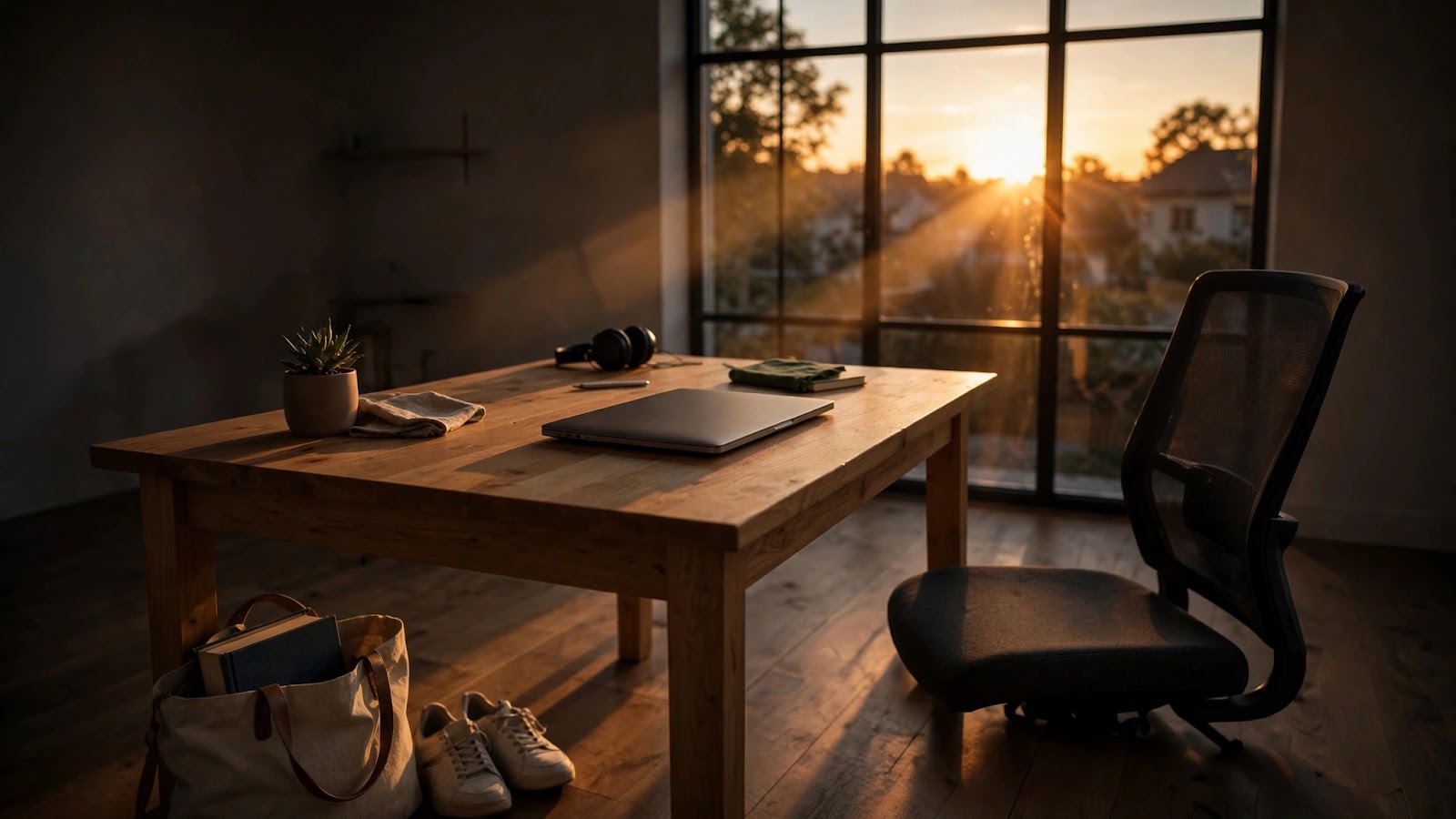
Instead, I did something different. I wrote the out-of-office message — but this time I wrote it like a letter to myself, not a formality for clients. It said: "I'm offline for the weekend and will respond to messages on Monday morning. If something is genuinely urgent, call me — and I'll decide whether it was actually urgent. (It probably wasn't.)"
That parenthetical was only for my own amusement. But the "call me" part was the key insight, and I'd recommend it to anyone: the message didn't say I was unreachable. It said the bar for reaching me was a phone call. Email is cheap; a phone call costs the client a small moment of social courage. That tiny bit of friction filters out about 99% of "urgent" weekend messages, because most of them were never urgent. They were just... Friday-afternoon thoughts someone wanted off their desk.
Then I did the harder part: I set my phone to Do Not Disturb for the whole weekend. Not silent — Do Not Disturb, with only calls from a few starred contacts allowed through. Email notifications: off. Slack: logged out. I put the laptop in my bag and put the bag in the closet. Out of sight, genuinely.
And then I sat on my couch and felt... itchy. That first Saturday morning was genuinely uncomfortable. Around 10 a.m. I had a physical urge to check my email, like a phantom limb. I made coffee. I picked up a book I'd been "meaning to read" for six months. By noon, the itch had faded. By Sunday, I'd forgotten about work for stretches of hours at a time — something that hadn't happened in years.
Monday morning: the world had not ended
Here's what I found when I opened my inbox on Monday at 9 a.m., braced for disaster: eleven emails. Three were newsletters. Two were "no rush" messages that had arrived Saturday and would have stressed me out for no reason if I'd seen them in real time. Four were normal Monday-morning business. One was a client saying "hope you had a good weekend!" — and one, exactly one, was something that actually benefited from a fast answer, which I gave within the hour.
Nothing had burned down. No client had left. The sky had not fallen. The catastrophe I'd been pre-working to prevent every weekend for three years turned out to be... eleven emails, most of them harmless.
That Monday taught me the central truth of the whole thing: my weekend work wasn't protecting my business. It was feeding my anxiety. The anxiety told me that constant vigilance was the price of freelancing; the evidence said the vigilance was mostly unnecessary. Once I saw that clearly, the out-of-office stopped being a struggle and became a habit. I kept the message. I kept the Do Not Disturb. I kept the laptop in the closet.
Did every weekend go perfectly after that? Of course not. There were weekends I caved — a big launch, a genuine emergency, a client in a different timezone whose crisis was real. But here's what changed: those became exceptions, not the default. Before, "working the weekend" was the plan and resting was the exception. After, resting was the plan and working was the exception. Flipping the default flipped everything.
What I tell clients now (the expectation-setting scripts)
The out-of-office message is the visible part, but the real system is the expectations I set before weekends ever come up. New clients hear this in my onboarding: "I work Monday through Friday. I don't check email on weekends — if something's genuinely urgent, call me, otherwise I'll pick it up Monday morning." Said matter-of-factly, like someone describing their office hours. Because that's what it is.
Here's what surprised me: clients like it. I expected pushback, especially from clients who are used to agency-style always-on service. What I got instead was respect — and, in a few cases, open envy. One client told me she wished she could do the same. Another said it made me seem more professional, not less, because it signaled that my time was managed rather than chaotic.
The key is saying it early. If you introduce weekend boundaries in the middle of a project, it can feel like a withdrawal of service. If it's in your onboarding — before there's any weekend to fight about — it's just how you work. It's infrastructure, not a negotiation.
For ongoing clients who were used to the old, leaky me, I gave it one transition month. I told them: "Heads up — I'm tightening up my schedule. From next month, I'm fully offline on weekends. Nothing changes about delivery times; I'm just batching my communication." Framing it around their benefit (delivery times unchanged) rather than my need (I'm tired) made it land smoothly. Not one of them objected.
The Friday shutdown ritual (how I make it stick)

The out-of-office handles the clients. But the harder problem was always me — the freelancer alone in her office on a Friday evening, knowing the laptop is right there. So I built a shutdown ritual, and this is the part I'd steal if I were you.
Every Friday at 5 p.m. (I set an alarm; the alarm is non-negotiable), I do four things. First, I write down every open loop — everything unfinished, everything I'm worried about, everything waiting on someone else. It goes on a single piece of paper, not in an app. Paper feels finished in a way a digital list doesn't.
Second, I look at Monday and write the first three things I'll do. Not the whole week — just Monday's first three tasks. This is the anxiety-killer. Sunday-evening dread is really just Monday-morning uncertainty wearing a costume. When Monday's first moves are already decided, the dread has nothing to feed on.
Third, I close every tab, quit every app, and shut the laptop down completely — not sleep, shut down. The thirty-second boot time on Monday is a feature, not a bug. It's a tiny speed bump that reminds my weekend self that opening the laptop is a deliberate act, not a reflex.
Fourth, I change my clothes. This sounds silly. It isn't. Work clothes off, weekend clothes on — it's a physical signal to my brain that the shift is over. Freelancers who work from home don't get the commute that used to mark the end of the day. You have to manufacture your own transitions, and this one takes ninety seconds.
The whole ritual takes about fifteen minutes. Fifteen minutes, once a week, and it buys me two full days. That's the best trade I've ever made in my business.
What my work gained (the part nobody believes until they try it)
The objection I hear most — and the one I believed for three years — is that working less means earning less. It feels like arithmetic: fewer hours, less output, less money. But freelancing isn't factory work. My output was never limited by hours; it was limited by the quality of my thinking, and my thinking was garbage when I was tired.
Here's what actually happened to my work after the weekends became real. Mondays got better — dramatically. I started the week rested instead of already depleted, and the difference in my first-draft quality was noticeable within a month. Fewer revisions, faster turnarounds, sharper ideas. The hours I "lost" on weekends came back as efficiency during the week.
And something subtler: I started having ideas again. The kind of ideas that don't arrive when you're grinding — the creative connections, the better angles, the "wait, what if we tried it this way" moments. Those live in the shower, on walks, in the middle of a lazy Saturday afternoon. A brain that's always working is a brain that never wanders, and wandering is where the good stuff happens. Some of my best client work in the last year started as a thought I had while doing absolutely nothing on a Sunday.
My income didn't drop. I won't claim it magically rose — that's the kind of story that sounds good in a headline and falls apart in real life. But it stayed steady, my client retention improved (rested freelancers are nicer to work with, it turns out), and I stopped dreading Mondays. If someone offered me a 10% raise in exchange for giving up my weekends again, I'd laugh. It's not for sale.
If you're going to try this, start this Friday
Don't wait for a quiet week — there's no such thing. Don't announce a grand new policy — just do it. This Friday at 5, run the shutdown ritual. Write the out-of-office. Put the laptop in the closet. Feel the itch on Saturday morning and make coffee instead.
And when Monday comes and the world hasn't ended, you'll have the only evidence that ever convinces anyone: your own. The boundary sticks not because you wrote a clever email, but because you proved to yourself, once, that the business survives your absence. Everything after that is just repetition.
Three years of leaky weekends, and the fix was an email I finally meant. If I'd known it was that simple, I'd have been furious. Instead, I'm just rested.


