For years, my Mondays started with a small panic. I would open my laptop, stare at my inbox, and try to reconstruct what I had been doing on Friday. Which project was waiting on feedback? Had I sent that invoice? Was there a call on Monday morning I had forgotten about? I spent the first hour of every week just figuring out where I was, and by the time I had my bearings, the morning was gone and I felt behind before I had done anything.
The funny part is that Friday evenings were the opposite problem. I would finish a task, feel a brief sense of relief, and then drift off without closing anything properly. Tabs stayed open, half-written emails sat in drafts, and loose ends piled up quietly over the weekend. Monday did not create the mess. Friday left it there, and the weekend just gave it time to look bigger.
The Friday I finally wrote it down
The change started on a Friday when I had a genuinely bad Monday hangover from the week before. I had missed a morning call because I never wrote it down, and I spent the rest of that Monday apologising and rearranging. That Friday, instead of just shutting my laptop, I grabbed a piece of paper and wrote down everything that was still open, everything I was waiting on, and the three things I most needed to do on Monday. It took about twenty minutes. The next Monday felt completely different, and not because the work had changed. Because I knew where to start.
That piece of paper became a checklist, and the checklist became a ritual. I do it every Friday now, usually in the last half hour of my workday, and I treat it as part of the work, not as extra admin I can skip when I am tired. Especially when I am tired, actually, because tired Fridays are when loose ends get dropped most easily.
Step one: close the loops you can close
The first part of the checklist is the most satisfying and the most useful. I go through my open messages and drafts and ask one question about each: can I close this today in under ten minutes? If yes, I do it now. That means sending the short reply, uploading the finished file, or confirming the time for next week's call. I do not start anything new in this window. This is only for finishing things that are ninety percent done.
There is a reason for the ten-minute limit. Without it, this step turns into another work session, and you end up working late on a Friday for no good reason. With it, you clear a surprising amount of small clutter. Last Friday I closed four items in twenty minutes: two replies, one file upload, and one invoice I had been meaning to send since Wednesday. None of them were hard. They were just unfinished, and unfinished things are heavy out of proportion to their size.

Anything that cannot be closed in ten minutes goes on the open list instead, with a note about what is blocking it. Waiting on the client for photos, waiting on my own draft, waiting until Monday for a decision. Naming the blocker matters, because on Monday I will not have to waste time wondering why something stalled. I will already know.
Step two: write Monday's first three tasks
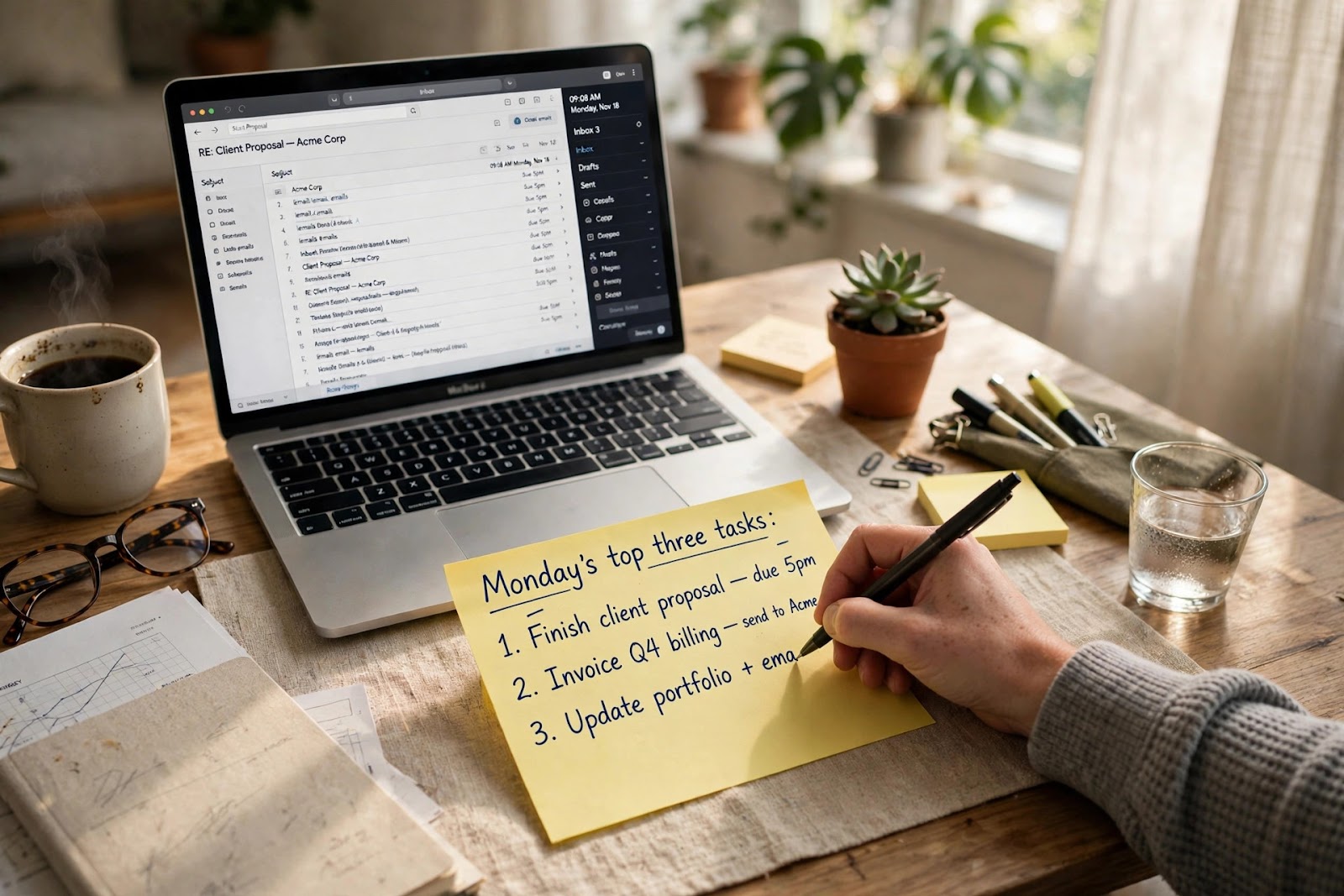
The second part is the heart of the whole ritual. I write down exactly three tasks for Monday, in order, and I stop at three. Not a long list, not a wish list, just three. The first task is the one I will do before I check email, because email will happily fill the whole morning if I let it. Usually that first task is the most important piece of client work, the one I would regret leaving until Tuesday.
Choosing only three forces a decision I used to avoid all week. I have to admit which things matter most, and which things can wait. On a recent Friday, my three were: finish the draft for one client, send the revised proposal to another, and reply to a new inquiry that had come in that morning. Everything else stayed on the open list. Monday morning, I did not have to decide anything. I opened the list and started. That sounds small, and it is small, but starting without deciding is the whole trick. Decision fatigue is real, and Monday mornings have enough of it already.
I keep this Monday list on paper, on top of my closed laptop, so it is the first thing I see when I sit down. Some weeks I take a photo of it on my phone too, in case the paper goes missing over the weekend. The point is that Monday me does not have to trust Friday me's memory. Monday me gets a clear instruction, written by someone who knew exactly what was going on.
Step three: tidy the desk and the files
The third part takes about ten minutes and sounds like housekeeping, but it changes how Monday feels. I close every tab I do not need, save every open file with a clear name, and put each finished file in the right project folder. I also clear my desk, stack the notebooks, and put my pen back where it belongs. It is not about being tidy for its own sake. It is about removing the visual noise that makes Monday feel overwhelming before you have even started.
I learned this from a week when my desktop was covered in files named final, final2, and final-real-this-time. On Monday I opened the wrong version of a document and sent it to a client, then had to send a correction ten minutes later. Embarrassing, and completely avoidable. Now, if a file is finished, it gets its proper name and its proper folder on Friday, while I still remember which version is which. Future me is not a detective. Future me is just tired, and deserves clear labels.
I do the same quick tidy with my inbox, in a light way. I do not try to reach zero, because that is a trap on a Friday evening. I just archive the newsletters, star the two or three messages that need a Monday reply, and leave the rest. The goal is not an empty inbox. The goal is an inbox that does not shout at you on Monday morning.
What I stopped doing on Fridays
The checklist also taught me what not to do. I stopped starting new projects on Friday afternoons, because a half-started project over the weekend becomes a guilty thought instead of a clean break. I stopped sending important emails late on Friday, because they either get ignored until Monday anyway or they start a back-and-forth that eats into my evening. If an email matters, I draft it on Friday and send it on Monday morning, when the client is actually there to read it.
I also stopped treating Friday evening as bonus work time. For a long time I told myself I was being dedicated by working into the evening, but most of that work was low quality, and it left me starting Monday already tired. The shutdown checklist is, in a way, permission to stop. Once the list is done, the laptop closes, and the weekend is actually a weekend. I come back on Monday rested, which is worth more than the extra hour I used to squeeze out of a Friday night.
How to build your own version
If you want to try this, keep it short at first. Your checklist does not need to look like mine. It only needs three parts: close what you can, write Monday's first three tasks, and tidy up so Monday you can find things. Time it. If it takes more than thirty minutes, something is wrong, probably that you are starting new work instead of closing old work. Trim it until it fits in half an hour.
Do it at the same time every Friday, and treat that time as booked, like a client meeting. The first two weeks will feel odd, and you will be tempted to skip it when a Friday gets busy. That is exactly when it helps most, because a busy Friday leaves the most loose ends. Even a rushed ten-minute version, just the Monday three tasks and a quick open list, is far better than nothing.
After a month of this, my Mondays changed in a way I can actually measure. I no longer spend the first hour reconstructing the week, I no longer miss Monday morning calls, and I no longer carry that low-level dread on Sunday evening about what I might have forgotten. The work itself is the same, the clients are the same, and my skills are the same. The only thing that changed is that Friday me now takes twenty minutes to look after Monday me, and Monday me is grateful every single week. If your Mondays start with panic, try closing your week properly first. You might find that Monday was never the problem at all.


