There is a particular kind of panic that only shows up when business is good. I hit it three years ago, in the middle of a spring where every enquiry seemed to turn into a yes. I had four projects running at once, a fifth starting the following Monday, and my inbox kept filling up with people who wanted to work with me. I should have felt triumphant. Instead, I felt trapped, because every new message forced the same miserable choice: squeeze the person in and burn myself out, or turn them away and watch a good client walk off to someone else.
For a while I chose the squeeze. I told myself I could handle one more small project, that the deadline was flexible, that I worked fast. I was wrong on all three counts, and my existing clients paid for it. Deliveries slipped by days. Emails went unanswered for a weekend. One client, a patient woman who ran a small bakery chain, finally wrote to ask whether everything was all right, and I realised she wasn't asking about the project. She was asking about me. That email embarrassed me more than any missed deadline ever had.
So I swung to the other extreme and started saying a flat no to everyone new. Clean, honest, professional — and expensive. Two of the people I turned away that month came back six months later, but by then they'd found other freelancers and were happy. I'd protected my schedule and lost the relationships. There had to be a middle option, and eventually I stumbled into it almost by accident: a waitlist. Not a fancy system, not a paid tool, just a list, a promise, and a habit of following through.
The week I stopped pretending I had room
The breaking point was a Tuesday. I had a discovery call booked with a potential client, a man opening a second café location who needed a full website refresh. The call went brilliantly. He liked my work, he liked my price, and he wanted to start the following week. I said yes before I'd checked my calendar properly, then spent the rest of the day moving pieces around in my head like a puzzle that had no solution. I had no week to give him. I had no honest start date at all.
That evening I did something I should have done months earlier. I opened a blank spreadsheet and wrote down every active project, its deadline, and the hours I realistically had left each week. The numbers were blunt. I was booked solid for seven weeks, with about four spare hours a week for small fixes and nothing else. Seeing it in black and white changed everything, because now I wasn't guessing about capacity. I knew it. And once I knew it, I could tell clients the truth instead of a hopeful fiction.
The next morning I emailed the café owner and told him the truth: I was fully booked until mid-June, but I'd love to do the project, and if he was willing to wait, I'd hold his place and check in every two weeks until we started. I expected him to walk away. He replied within an hour saying that was fine, that he'd rather wait for the right person than start over with someone new, and could I send him the deposit details. That reply rewired my brain. A waitlist wasn't a rejection. It was a reservation.
What my waitlist actually looks like
People imagine a waitlist needs software. Mine started as a spreadsheet with six columns, and honestly it still is one, though I've tidied it since. The columns are: name, project type, date they enquired, the date I told them I'd be free, a one-line note about the project, and the last time I contacted them. That's it. No CRM, no automation, no monthly fee. The simplicity is the point — if the system needs more upkeep than the clients on it, I'll stop using it, and a dead waitlist is worse than no waitlist at all.
I cap the list at eight people. That number came from hard experience, not theory. When I let it grow to fifteen once, during a busy autumn, it turned into a source of guilt. I couldn't contact fifteen people meaningfully, some of them waited four months, and by the time I reached them, half had moved on. Eight is the number I can keep warm with a short message every two or three weeks without it eating my Fridays. If the list is full, I say so, and I offer the honest alternative: a referral to a freelancer I trust, or a note to contact me again in two months.
Order matters, and I learned to be explicit about it. The list runs first-come, first-served, with one exception: returning clients jump one place, not to the front. I tell new enquirers this plainly. People respect a queue they can see, even a rough one. What they don't respect is silence, or a vague "I'll let you know" that never turns into anything. A waitlist only works if the people on it believe it moves.
The email I send when I'm full
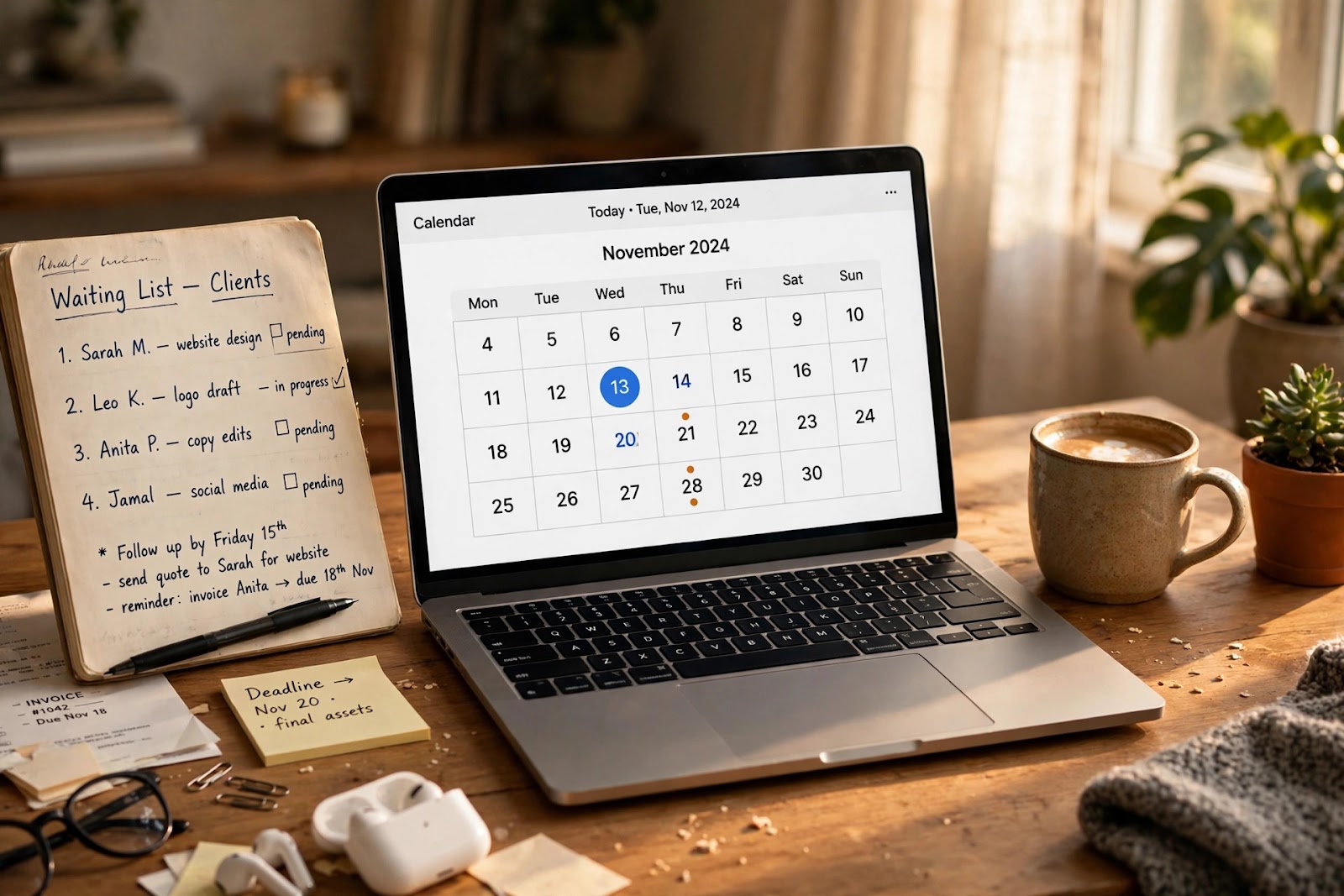
The exact words matter here, because this email does two jobs at once: it says no to now, and yes to later. Mine is short, warm, and specific, and I've refined it over dozens of sends. It goes roughly like this: thank you for getting in touch, I'm fully booked until a specific date, I'd genuinely like to work on this project, and here's what happens next if they're happy to wait. Then I give them the next step, not a vague promise — a deposit to hold the slot, or a date for a check-in call, or a short questionnaire so I can start thinking about their project.
The specific date is doing most of the work in that email. "I'm fully booked" on its own sounds like a polite brush-off. "I'm fully booked until the week of June 16th" sounds like a professional with a diary. Clients can plan around a date. They can't plan around a feeling. I only ever give a date I'm confident about, and I add a week of buffer to it in my own head, because the worst thing a waitlist can do is make someone wait past the date you promised and then go quiet.
Then comes the part most freelancers skip: I ask them a question. Something about their project — their launch date, their biggest worry, the one thing the new website has to do. It takes thirty seconds to answer, and it changes the dynamic completely. They're no longer a name in a queue. They're a person with a project I've already started thinking about. When I follow up two weeks later, I can ask about that specific thing, and the conversation picks up where it left off instead of starting cold.
Keeping the list warm without being annoying
A waitlist dies in silence. I learned that the embarrassing way, when a client I'd waitlisted for two months emailed me to ask whether I'd forgotten him. I hadn't forgotten him. I'd just been busy, and busy had quietly turned into three months of nothing. He took the project elsewhere, and he was right to. Now I treat the check-in as a non-negotiable part of the system, scheduled like any other piece of client work.
Every second Friday, I spend about forty minutes on waitlist messages. Each one is short and personal: a line about their project, a line about where things stand, and something useful — an article, a quick thought about their launch, a question that moves their thinking forward. I never send a mass update. People can smell a copied message from a mile away, and a waitlist built on copied messages feels like a holding pen, not a relationship.
The check-ins do a second job I didn't expect: they filter the list for me. Some people reply enthusiastically every time. Some go quiet after the second message. Some tell me their plans changed and they don't need me anymore, and they thank me for keeping in touch. That's not failure. That's the list doing its job. By the time a slot opens, I know exactly who is still serious, and I never waste a free week on someone who stopped caring two months ago.
I also use the check-ins to manage my own pipeline honestly. If a project runs long — and they do, about a third of the time — I tell waitlisted clients before they have to ask. A short message saying "the project ahead of you slipped by a week, so your start moves to the 23rd" is annoying to send but easy to receive. Clients forgive delays they hear about in advance. They don't forgive finding out after the date passed. This one habit has saved me more relationships than any other part of the system.
Deposits, and why I take a small one
Here's the part that made me nervous at first: I ask waitlisted clients for a small deposit, usually ten percent, to hold their slot. I worried it would scare people off. It did the opposite. The deposit turned the waitlist from a vague intention into a real booking in the client's mind, and it turned my list from a pile of maybes into a pipeline I could plan around.
The deposit also protects both sides. If a client changes their mind, they lose a small amount, but they've had weeks of my attention and honest updates, so it rarely feels unfair — and I refund it in full if I ever have to cancel or push a start date beyond what I promised. If I change my mind about a project after the waitlist period, which has happened once, I refund it immediately and help them find someone else. The money isn't the point. The commitment is. A list with no commitment attached drifts. A list with a small stake attached stays real.

One caution, learned the hard way: never take a deposit from more people than you have slots for. Early on I got excited, took deposits from twelve people for eight eventual slots, and spent a miserable month untangling it. Now the rule is simple. Eight names, eight deposits at most, and when the eighth deposit lands, the list closes until a slot opens. Scarcity that is honest is fine. Scarcity that is invented is just a mess waiting to happen.
When someone on the list isn't right after all
Sometimes the waiting period reveals that a project isn't a good fit, and that's actually one of the waitlist's hidden gifts. A rushed yes locks you into a project you haven't thought about. A four-week wait gives you time to notice the red flags: the client who replies to every check-in with a new demand, the scope that quietly doubles before you've started, the budget that keeps getting described as "flexible" in ways that only ever flex downward.
When that happens, I say so early and kindly, and I refund the deposit on the spot. I frame it as a mismatch, not a rejection: the project needs someone with a different strength, or a faster turnaround than I can honestly offer. Twice, those clients have referred other people to me anyway, because being told "I'm not the right person for this" with honesty and a referral feels better than being squeezed in and resented. A waitlist that only ever says yes is just a delayed version of overbooking.
There's a flip side I should mention, too. Sometimes the wait makes a client more committed, not less. The café owner I mentioned earlier? By the time we started, he'd spent six weeks thinking about his website, and he arrived at our kickoff call with clearer goals than any client I'd ever had. He'd used the waiting time well. That project went smoother than most, finished two days early, and he's now sent me three referrals. Waiting, handled well, doesn't cool a client down. It warms them up.
The numbers, honestly
I keep rough track of what the waitlist produces, because I don't trust a system I haven't measured. Over the last two years, about seven out of ten waitlisted clients have gone on to become paying projects. Two out of ten have drifted away or changed plans during the wait, usually politely. One out of ten has turned out to be a bad fit I was glad to spot early. Those numbers are good enough that I stopped questioning whether the system works, and started asking how to run it better.
The financial effect surprised me, too. Before the waitlist, a fully booked month was followed by a scramble — I'd finish projects, look up, and realise I had nothing lined up, because I'd said no to everyone during the busy period. Now, a busy month ends with a queue of warm, deposit-paid clients ready to start. The feast-and-famine cycle that used to define my income has flattened out considerably. I still have quiet weeks, but they're planned now, not panicked.
If you're fully booked right now and reading this with a full inbox, here's where I'd start. Tonight, write down your real capacity for the next eight weeks — not your hopeful capacity, your real one. Tomorrow, reply to your newest enquiry with a specific date, a real next step, and one good question about their project. Start a list, cap it at a number you can actually keep warm, and put a recurring check-in on your calendar before you forget. That's the whole system. The rest is just doing it consistently.
The shift that matters isn't the spreadsheet. It's the mindset: being fully booked stops being a problem to apologise for, and starts being proof that your work is wanted. Clients don't mind waiting for something good. They mind being ignored, misled, or forgotten. Give them a date, give them a next step, and keep showing up in their inbox while they wait. That list is the reason I can say no today without worrying that I am closing a door — because I know exactly where the door leads, and when it opens next.


