I woke up on a Tuesday with a throat like sandpaper, a head full of cotton wool, and a deadline on Thursday. The project was a set of landing pages for a returning client, about two-thirds done, and the first draft was due in forty-eight hours. My first thought wasn't about rest. It was about the email I'd have to send.
Freelancers don't get sick days. There's no HR form, no colleague to cover your shift, no paid leave sitting in a bank somewhere. There's just you, a calendar full of promises, and a body that has decided today is the day it stops cooperating. I'd never once planned for being ill. That Tuesday taught me the lesson by nearly costing me a deadline I'd promised in writing.
I didn't miss it. But only just. And what saved me wasn't heroics or an all-nighter fuelled by cold medicine. It was a short, honest email, a day I'd quietly held in reserve, and a plan I'd scribbled on a notepad once I could think straight again. Here's the whole thing, exactly as I use it now.
The email I sent that morning
Here's the mistake I made the first time I got sick on a job, years earlier: I said nothing. I told myself I'd feel better by lunchtime, then by evening, then tomorrow morning. By the time I admitted I was behind, I was a full day late and the client had already started wondering whether I'd vanished. Silence is the worst possible sick-day strategy. Clients can handle a delay. They can't handle not knowing.
So that Tuesday, before I'd even made tea, I sent this:
Hi Sarah, quick heads-up — I've come down with flu overnight and I'm running at about half speed today. The draft is still on track for Thursday, but I wanted you to know in case anything slips. I'll update you again tomorrow morning either way. Thanks for understanding.
That's it. Four sentences. No dramatic detail about my symptoms, no apology tour, no promise I couldn't keep. I named the situation, I named the effect on the work, I gave a new check-in time, and I stopped writing. The whole thing took ninety seconds, and it changed everything about how the next two days went.
She replied within the hour: feel better, no rush, Thursday still works. That reply was worth more than any medicine. The pressure dropped out of the day, and instead of panicking about the deadline while feeling awful, I could actually rest and then do the small amount of work I was capable of.
I've sent some version of that email half a dozen times since, and the pattern holds: tell them early, tell them plainly, give them a time for the next update. Clients can handle a delay. They can't handle finding out late.
What I do on a sick day now (the three levels)
The hardest part of a sick day isn't the illness. It's deciding what counts as working when you feel terrible. Left to my own devices, I either push through and produce garbage I have to rewrite, or I collapse completely and lose a day I could have used for the easy stuff. So I made myself a simple rule with three levels, and I stick to it even when my brain is foggy, because the decision is already made.

Level one is a green day. I'm rough — sore throat, tired, a bit slow — but I can think. On a green day I work in short bursts, forty-five minutes at a time, and I only touch the easy parts of the job. Formatting, tidying, admin, the bits that don't need my best brain. I never write fresh copy or make big decisions on a green day. That work can wait until I'm sharp again.
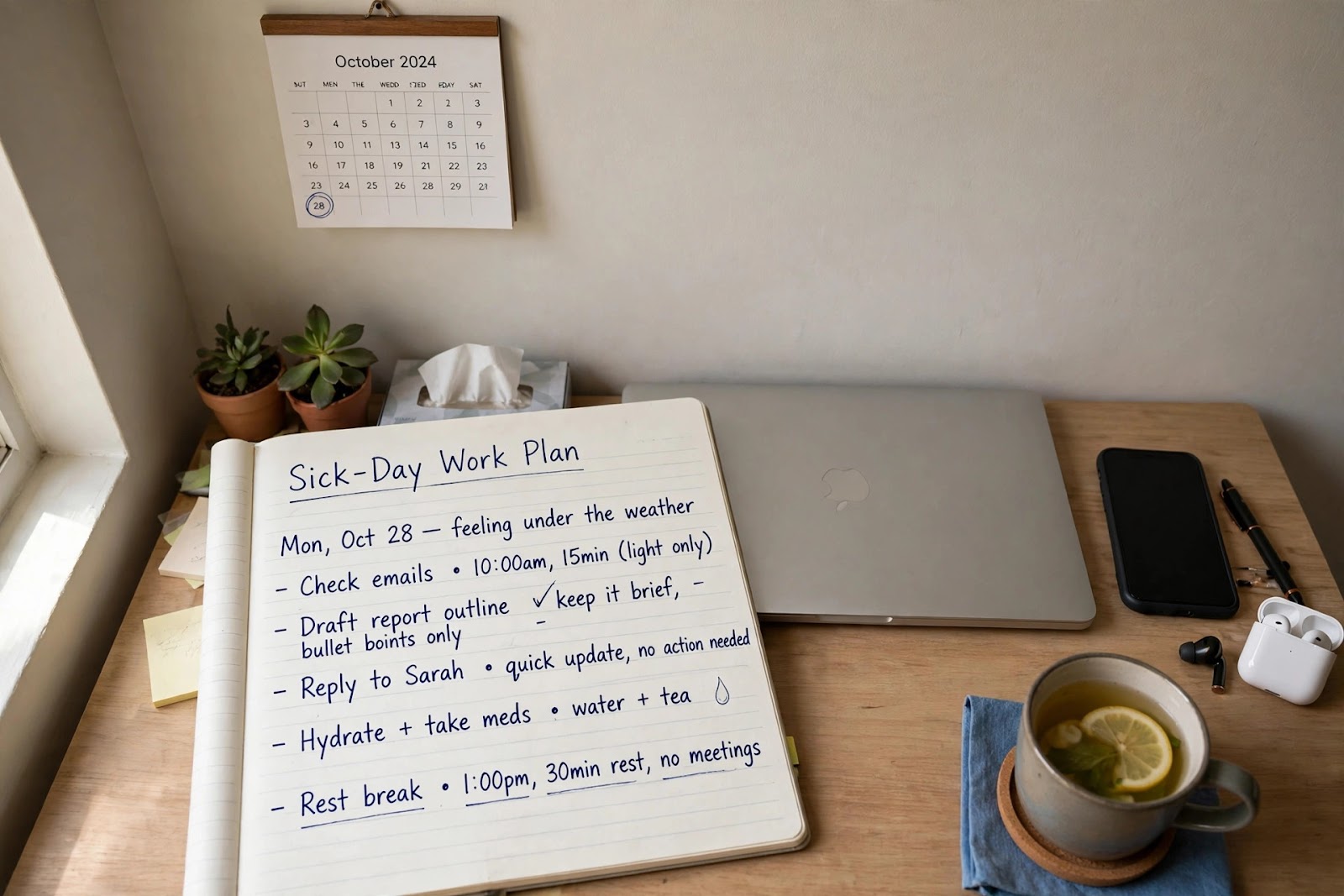
Level two is a yellow day. I can sit up and answer emails, but real work is out of the question. On a yellow day I do exactly three things: send the update email if I haven't already, move any calls to later in the week, and write a short note to myself about where each project stands, so tomorrow-me doesn't have to reconstruct it through a fog. Then I stop. The laptop closes. That's the whole day.
Level three is a red day. I'm in bed, properly ill, and I shouldn't be near a screen at all. On a red day I do one thing only: a single short message to any client with work due in the next forty-eight hours. If I can't even manage that, my partner sends it from a template saved in my phone notes. Then the phone goes away.
The buffer that saved the Thursday deadline
Here's the part I almost didn't include, because it sounds too simple to matter. The reason I hit that Thursday deadline wasn't the email. It was a habit I'd picked up almost by accident the year before: I never promise the earliest date I could deliver. I promise one day later.
When a client asks when they'll see a draft, my honest answer is usually Wednesday. I say Thursday. That extra day isn't padding I charge for — the fee is the same, the work is the same. It's a quiet day held in reserve for exactly this kind of thing: illness, a power cut, a family emergency, a file that corrupts itself at the worst possible moment. Most weeks, the buffer day just means I deliver a day early and look organised. On a sick week, it's the difference between on time and late.
That Tuesday, the buffer did its job. I spent Tuesday mostly resting, worked a gentle green-day shift on Wednesday, and delivered on Thursday morning as promised. The client never knew how close it had been, and they didn't need to. The buffer isn't a trick. It's me being honest with myself about the fact that I'm a human being with one body and no backup.
If you take one thing from this article, take this: stop quoting your best-case date. Your best-case date assumes nothing goes wrong, and something always goes wrong eventually. Quote the date you can hit even on a bad week. Clients remember reliability far longer than they remember speed.
The backup person I wish I'd lined up sooner
There is one scenario the buffer can't fix: being properly ill for a week or more. I found that out the hard way during a nasty bout of flu two winters ago that knocked me flat for six days, right in the middle of a project with a hard launch date. The buffer covered two days. The other four were a problem I had no answer for, and I ended up working from bed on day five, feverish and miserable, because I couldn't see another option.
After that, I did something I'd been putting off for years. I found a backup person. Not an employee, not an agency — just another freelancer in a similar field whose work I trust, and we made a simple deal. If one of us is ill or in an emergency, the other can step in on the straightforward parts of a job: formatting, basic edits, answering a client email with the facts. We swap a small fee for the favour, and we each keep a short handover note for active projects so the other one isn't starting blind.
We've only used the arrangement twice in two years, both times for a day or two, not a full takeover. But knowing it exists changed how I feel about getting sick. The dread is gone. I don't lie awake wondering what happens if this flu turns into something worse. There's an answer, and it's a person, not a panic plan.
If you don't have someone like that, start looking now, while you're well. Ask in a freelancer group, or among people you've worked alongside before. Frame it honestly: a mutual arrangement, no commitment unless something goes wrong. Most freelancers are relieved to be asked, because they've been worrying about the same thing.
The day I'm back: how I catch up without burning out
The comeback day is where most freelancers undo all their good sick-day work. You feel better, the guilt kicks in, and you try to do three days of work in one. I've done it. It ends with you ill again by Friday, and nobody wins.
So my first day back has a rule: I do the work that was due, and nothing else. No catching up on every email, no starting the next project early, no admin marathon. I open my handover note from the sick days, I look at what's actually due, and I do that. Everything else waits until tomorrow, when I'm properly back.
I also send a short closing message to any client I updated while I was ill: thanks for your patience, I'm back, the draft is with you. Clients like the loop closed, and it costs me two minutes. It also marks the end of the incident in my own head, which matters more than it sounds.
One more thing I do on the comeback day: I write down what went wrong. Not a diary entry — just three lines in a notes file. What day I got ill, what the plan handled well, and what gap it exposed. That file is how the three-level system and the backup arrangement exist at all. Each illness made the plan a little better, and now it mostly just works.
What I'd tell myself before that first sick day
If I could go back to the freelancer I was five years ago — the one who worked through a fever because asking for an extra day felt like admitting defeat — I'd tell him three things. First, clients don't hire you for your immune system. They hire you for your work, and a day's delay on good work beats on-time work done badly while you're half-conscious.
Second, the email is always easier than you think. I spent an hour dreading a ninety-second message the first time. Every client I've told has been kind about it. The fear of telling them is almost always worse than telling them.
And third, a sick-day plan isn't pessimism. It's the same as backing up your files or keeping a spare charger. You're not planning to fail. You're planning for the week when life happens, so that when it does, you have something to reach for instead of panic. Build it while you're well, keep it somewhere you can find it with a fever, and trust it when you need it.
I'm writing this on a perfectly healthy Wednesday, which is exactly the right time to write it. If you're reading this feeling fine, that's your moment too. Send the backup message, save the email template, and add one day to your next deadline. Future-you, the one with the sore throat and the Thursday deadline, will be very glad you did.


