My first "holiday" as a freelancer lasted four days, and I worked through three of them. I was sitting in a beach café in June, laptop open, replying to a client about a logo revision while my friends ordered lunch without me. The Wi-Fi kept dropping, the file wouldn't upload, and by the time I finally sent it, the food was cold and I'd spent the best part of the afternoon staring at a screen I'd flown 800 miles to escape. That wasn't a holiday. That was my office with better weather.
Three years later I took a real two-week holiday. Fourteen days, no laptop, no client calls, no "just checking in" emails. When I came back, every client was still there. One of them hadn't even noticed I'd been away. The difference wasn't luck. It was a system I built after that miserable beach-café afternoon, and I've used it four times since. Here's exactly how it works.
Step one: pick the dates six weeks out, and tell yourself first
The biggest mistake I made in my first two years wasn't poor planning. It was never deciding to go at all. I'd say "I'll take a break when things quieten down" and things never quietened down, because freelance work doesn't quieten down on its own. There's always one more project, one more inquiry, one more "quick" job that pays well.
So now I book the holiday before I feel ready for it. Six weeks out, minimum. I put the dates in my calendar, I book the flights or the hotel, and I pay for something non-refundable. That last part matters more than it sounds. A holiday that costs nothing to cancel will get cancelled the first time a good project lands. A £180 train ticket you can't refund is a surprisingly strong commitment device.
I also block out two buffer days, one before I leave and one after I get back, and I treat them as part of the holiday. The day before is for finishing, handing over, and closing tabs. The day after is for email triage and easing back in. Without those buffers, the holiday starts with a frantic all-nighter and ends with 200 unread emails and a panic attack. With them, the edges are soft.
Step two: tell clients in layers, not all at once
I used to send one big announcement email to everyone and hope for the best. It backfired, because clients read "I'm away for two weeks" as "your project is paused for two weeks," even when it wasn't. Now I tell people in layers, and I tailor the message to the relationship.
Retainer clients and anyone with live work get a personal email four weeks out. Short, specific, and calm. I tell them the exact dates, what will be finished before I go, and who to contact if something genuinely breaks. I never apologise for taking time off. Employees don't apologise for annual leave, and neither should I. I just state it like the normal business fact it is.
Everyone else — past clients, occasional clients, warm leads — gets a one-line mention in my regular emails from about two weeks out. "Just a heads-up, I'm away from the 12th to the 26th, so anything after that date gets my full attention." No drama, no long explanation. Most of them reply with "enjoy it" and move on.
And here's the part that surprised me: telling clients early actually wins work. Twice now, a client has moved a project forward so it lands before my holiday, or booked me for the week I return, because the deadline in my email made them decide. A holiday date is a deadline, and deadlines make clients act.
Step three: the handover note nobody taught me to write
The single most useful document in my whole business is a one-page handover note. I write one for every live project before a holiday, and it takes about twenty minutes per client. It has four sections: where the project stands, what's already delivered, what's due next and when, and what could go wrong while I'm away.
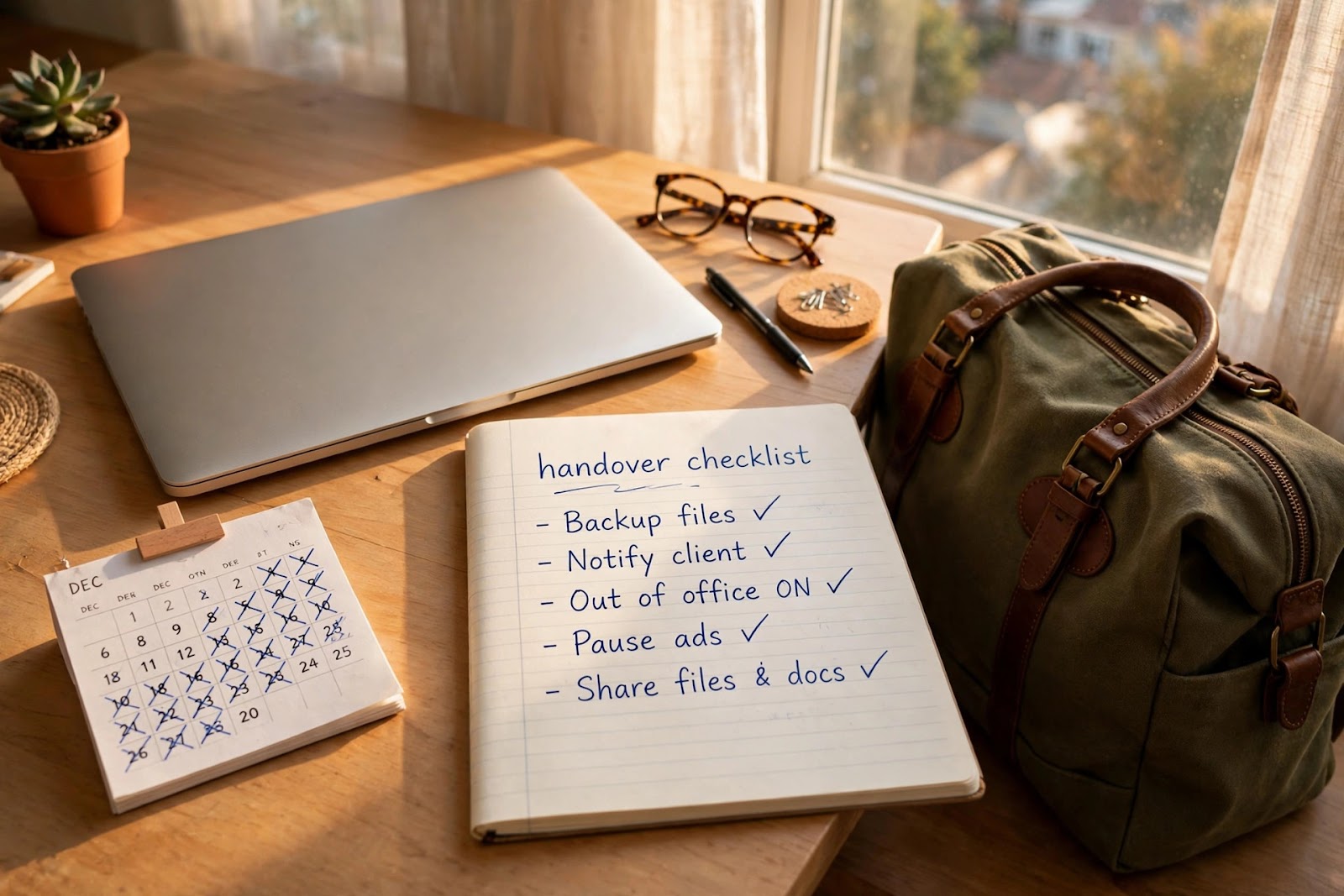
The "what could go wrong" section is the one that saves you. For a website client, that's the login details, the hosting support number, and a note saying the contact form plugin sometimes needs a manual update. For a writing client, it's the name of the editor who can approve a draft in my absence. I don't ask anyone to do my work. I just make sure that if something breaks, the client isn't staring at a wall of silence wondering whether I've vanished.
I send the handover note three days before I leave, not the morning of. That gives the client time to read it and ask questions while I'm still at my desk. The one time I sent it the night before a flight, the client replied with three questions at 11pm and I spent my first holiday morning answering them from the airport. Never again.
One more thing about the handover: I keep a copy for myself. On my return day, that note is my map back into the work. I don't have to reconstruct where anything stood from memory. I just open the note and pick up where I left off.
Step four: finish or freeze, never half-do
Before every holiday I sort every open job into two piles: finish or freeze. "Finish" means the work is delivered, approved, and invoiced before I leave. "Freeze" means it's formally paused with the client's agreement, with a restart date written down.
What I never do any more is leave something half-done with a vague "I'll pick this up when I'm back." Half-done work is what haunts a holiday. You lie on a beach thinking about the draft you owe, and the client emails on day nine asking where it is, and suddenly you're drafting in your head instead of resting.
This sorting exercise usually reveals something useful: one or two jobs in the "freeze" pile don't actually need to exist. A client who hasn't replied in three weeks, a project that's been "almost ready to start" for a month. I use the pre-holiday clear-out to close those loops — a polite email, a clean ending, a line drawn. I come back to a lighter workload every single time.
Step five: the out-of-office message that does the work for you
Most out-of-office messages are useless. "I'm away until the 26th" tells a stranger nothing. Mine has three lines: the return date, what to do if it's urgent, and when I'll reply to everything else.
Something like: "I'm on holiday until Monday 26th with no access to email. If something is genuinely urgent, contact [name] at [email]. Otherwise I'll reply within two working days of my return." That's it. No apologies, no jokes, no "I'll have limited access" — because "limited access" is an invitation to test the limits, and someone always will.
I also set up one practical thing most freelancers skip: I turn off email on my phone entirely. Not silent, not on low notifications — removed. The app comes off the home screen and I sign out. If I can check email "just once," I will check it forty times, and each check pulls me back into work mode. The only way I truly disconnect is to make checking hard. On my last trip, my phone lived in the hotel safe for most of the day, and honestly, it was the best part of the holiday.
Step six: pay for the holiday before you take it
Here's the part nobody talks about when freelancers discuss time off: the money fear. Two weeks away means two weeks of no income, plus the cost of the trip itself. In my first year, that maths kept me at my desk for eleven straight months. I was exhausted, my work was getting sloppy, and I still couldn't afford to stop.

What fixed it was a boring habit: I put 10% of every invoice into a separate savings pot labelled "time off." Not a business account, not a tax pot — a separate pot I can see growing. A £2,000 month puts £200 in the pot. After five or six months, there's enough to cover two quiet weeks plus the trip. The money was already earned; I just stopped spending it before the holiday arrived.
I also invoice everything before I leave. Any work delivered in the two weeks before the holiday gets invoiced the same day, not "when I'm back." That way money lands while I'm away, which does wonders for actually relaxing. On my last trip, two payments arrived mid-holiday, and I didn't even check them until I was home — but knowing they were coming meant I never once did the anxious maths in my head.
What if something actually breaks?
People always ask me this, and it's a fair question. In four holidays, something has gone wrong exactly once. A client's website went down on day five of a ten-day trip. They emailed my emergency contact — a fellow freelancer I'd arranged to cover urgent issues — and she restarted the hosting service in twenty minutes. The client never needed me at all.
That arrangement is the key. I have a reciprocal deal with one trusted freelancer in a similar field: she covers my emergencies, I cover hers, and we each pay the other their hourly rate if a real job comes up. It costs nothing unless it's used, and it turns a holiday-ending crisis into a twenty-minute fix. If you don't have someone like that yet, find them before your next trip. One honest conversation over coffee is all it takes.
And if there's no emergency contact and something breaks anyway? The honest truth is that most freelance work can wait two weeks. A blog post can wait. A logo revision can wait. The only things that can't wait are live websites and paid advertising, and those are exactly the things you plan for in the handover note. Everything else is just urgency theatre, and it feels a lot less urgent from a beach.
The return day (and why I don't answer email on it)
My buffer day back is sacred. I don't book client calls, I don't open my inbox before lunch, and I don't try to "catch up" in one heroic sprint. Instead I do three things: I read my handover notes, I triage the inbox into "today," "this week," and "not real," and I reply to the "today" pile only. Usually that's four or five emails. The rest waits.
This sounds lazy. It's not — it's the reason the holiday actually sticks. If you return to a 14-hour catch-up day, your body learns that holidays end in punishment, and next time you'll resist taking one. A gentle return day means the rest carries into the working weeks that follow. I do my best work in the two weeks after a holiday, every time, and I'm convinced the slow landing is half the reason why.
One last thing. On my most recent trip, a long-term client emailed me on day three. Not about work — just to say she'd seen my out-of-office message, hoped I was having a good break, and that she'd send the brief when I was back. She didn't need me. She just wanted me to enjoy myself. That's when I knew the system worked — not because nothing went wrong, but because my clients had learned, finally, that I come back better when I actually go away. Book the time off first, then build the system around it. The work will still be there when you get back, and so will your clients.


