My Laptop Died 12 Hours Before Delivery — How a $49 Drive and a Cloud Folder Saved the Project
I still remember the sound my laptop made when it died. Not a crash or a beep. Just a soft click, like a light switching off in another room, and then silence. The screen went black at 9:40 on a Tuesday night, twelve hours before I was supposed to deliver a finished brand guide to a client who had already paid me half of an $1,850 fee. I stared at it for ten seconds, waiting for it to come back. It did not.
The project was a full brand guide for a small skincare company: about 4,200 words of copy, a tone-of-voice section, twelve social media templates, and logo files I had been polishing for three weeks. The client had a launch on Friday and a press embargo lifting Thursday morning. My deadline was Wednesday, 9 a.m. I had roughly 90 percent of it done, and every bit of it lived on that laptop.
Here is the part I am not proud of. My first reaction was not to reach for a backup. It was to press the power button again. And again. Then I tried a different charger, then the charger in a different socket, as if the wall was the problem. None of it worked.
I panicked quietly, in my kitchen, with the fridge humming. Then I did the one thing that mattered that night. I stopped touching the laptop and started thinking about where else my work existed.
The Night My Laptop Gave Up
The night itself was not the disaster. It had been building for months, and I had not noticed.
My laptop was five years old, a mid-range machine from when I first went full-time freelance. It had been warning me for weeks: four-minute startups, a fan that sounded like a hair dryer, and a screen that had flickered black twice in the previous month. Both times I had shrugged and kept working. I told myself I would deal with it after this project. That sentence was a lie every time I said it.
The night it died, I had been working since 7 in the morning. I had just finished the last social media template and was saving the final version of the brand guide when the screen went black mid-save. Mid-save. For a horrible minute I was convinced the file itself was corrupted, not just the machine.
Then I sat down with a pen and paper and wrote down every place my work might exist outside that laptop. The list was shorter than I wanted.
The 40 Minutes That Decided Everything
The first item on my list was the cheapest thing I owned that week. About four months earlier, I had bought a 1TB external hard drive on sale for $49. A basic black Seagate, nothing fancy. I had bought it after reading a post by another freelancer who had lost a whole month of work to a stolen laptop, and for once I had actually acted on someone else's warning instead of filing it under "someday."
Here is the embarrassing part: I had plugged it in exactly twice. The first time, I copied my main client folders onto it and felt very proud of myself. The second time, about six weeks later, I copied the new stuff over and promised myself I would do it every Friday. I never did.
But that one six-week-old copy mattered more than I could have guessed. It had the brand guide at about 70 percent complete: the tone-of-voice section, the messaging framework, the first eight templates. Rebuilding from 70 percent in one night was brutal. Rebuilding from zero would have been impossible.
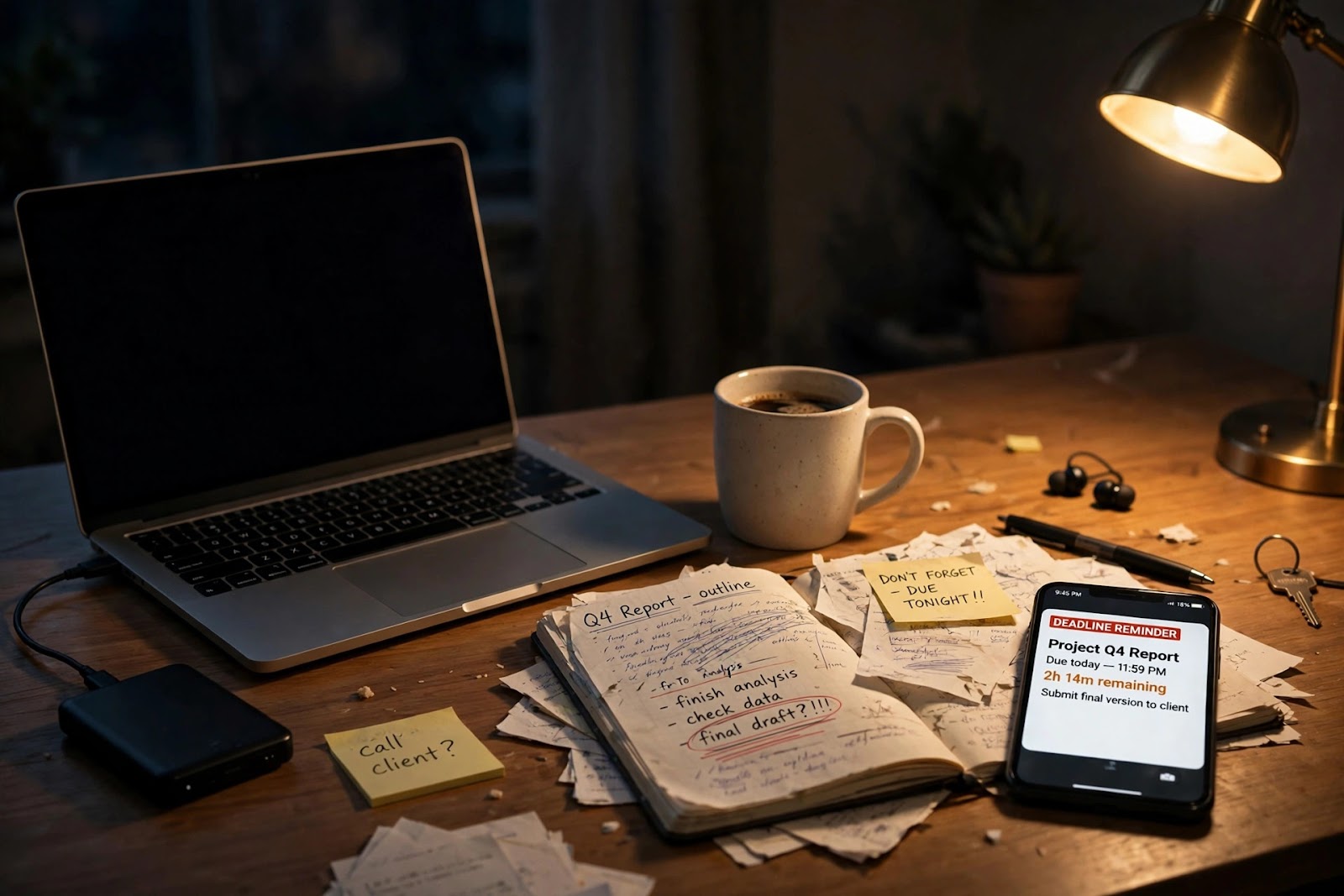
The second item on my list was better. Google Drive. I had set up the desktop sync app two years earlier, mostly so I could open files on my phone, and it had been quietly copying my working folder to the cloud the whole time. I had never once thought about it.
I opened Drive on my phone, hands shaking a little, and searched for the brand guide. There it was. The file timestamp said 9:12 p.m., twenty-eight minutes before the laptop died, and it had everything except the last template and the final polish pass. Twenty-eight minutes of work lost. That was the whole disaster, once you stripped away the panic.
I borrowed my brother's old laptop — slow, an hour of battery, two sticky keys — and it opened the file. I worked on it from 10:45 p.m. until just after 3 in the morning, rebuilding the last template from my notebook notes. I sent the finished guide at 6:40 a.m., more than two hours before the deadline.
I did not tell the client about the laptop. There was nothing to tell them that would have helped them. The work was done, on time, in full. The disaster had happened to me, not to them.
What Actually Saved Me (It Was Not Luck)
People hear this story and say I got lucky. I did not. I got saved by two habits I had set up half-heartedly and then mostly ignored. My $49 drive and my cloud sync were both imperfect. Together, they covered each other's gaps.
The drive was six weeks out of date, but it held everything in full, including the big design files too large to sync quickly to the cloud. The cloud was current to within half an hour, but it only held my working documents. One without the other would have left me short.
That night taught me something I now tell every freelancer who will listen: you do not need a perfect backup system. You need two imperfect ones that fail in different ways. A drive fails when you forget to plug it in. A cloud sync fails when your internet is down. If your two backups do not share the same weakness, one of them will be standing when you need it.
The second thing that saved me was boring: my file names. I name every project file with the date and a version number, like BrandGuide_2026-11-24_v07.docx. That night, it meant I could look at the cloud folder on my phone and know in ten seconds which file was the newest, instead of opening five files called "final," "final2," and "FINAL-final-really."
The third thing was my notebook. I keep a paper notebook next to my desk and write down decisions as I make them: the client picked the warmer green, the headline is 14 words max. That night, the notebook held the exact wording for the one template I had to rebuild from scratch. Three sources, none of them fancy, and between them I lost twenty-eight minutes of work instead of three weeks.
The Email I Sent at 1:12 in the Morning
There is one part of the story I left out, and it is the part I am proudest of. At 1:12 a.m., halfway through rebuilding the last template on my brother's wheezing laptop, I sent the client a short email. Not about the laptop. About the launch. Three lines: the guide would be in their inbox before 9 a.m. as promised, the press-ready one-pager they had asked about was included on page two, and I would be available on Thursday morning if anything needed a quick tweak before the embargo lifted.
Why does that email matter? It is the difference between a freelancer who disappears during a crisis and one who stays visible. It took ninety seconds to write, and it did more for that relationship than the brand guide itself. The client replied at 7:30 the next morning, before I even sent the files, saying thanks.
When something goes wrong on your side, the client should feel more communication, not less. Silence is what makes clients nervous. I did not lie to them. I simply did not hand them a problem they could not solve.
My Backup System Now: Less Than One Lost Client

Here is the system I use now, because vague advice is useless and this is the part of the story that actually protects your income.
First, the cloud. I pay $1.99 a month for 100GB of Google Drive storage, and my working folder syncs to it automatically. Every active project lives in that folder, and nothing active lives anywhere else. The free 15GB plan would cover most freelancers starting out. The point is that it happens without me thinking about it.
Second, the drive. I still have that same $49 drive, plus a second one I bought for $55. Every Friday at 4 p.m., I plug in a drive and copy the whole working folder — about fifteen minutes, done while I write my invoice list for the week. One of them lives in a drawer in a different room from my desk, because your backup should not die in the same accident as your original.
Third, the monthly check. Once a month, on the first Friday, I actually open a file from the backup and make sure it works — a real document, a design file, check that the images load. A backup you have never tested is a hope, not a backup. Five minutes.
Fourth, the naming. Every file gets a date and a version number, no exceptions. No "final," no "new," no "updated." It is boring and fussy, and it is the reason I found the right file on my phone in ten seconds on the worst night of my freelance year.
The whole system costs me $1.99 a month and fifteen minutes a week, plus the two drives, which came to $104 total. One lost client would have cost me $1,850 on that project alone. The maths is not close.
The Mistakes I Will Not Make Twice
I made three mistakes that year, and they are the same three I see other freelancers making right now.
The first was trusting one machine. My laptop was my office, my filing cabinet, my archive, and my delivery system, all in one box I carried around in a bag. If your whole business fits on one device, it can die with one device.
The second was treating backups as a chore I would get to later. I had the drive, the cloud account, even the setup — but I treated the maintenance like flossing, something I believed in and rarely did. The work I lost was twenty-eight minutes. It could have been six weeks. Do not build a system that depends on you remembering to run it. Build one that runs itself.
The third was ignoring the warnings. The slow startups, the fan, the flickering screen. My laptop had been telling me for a month that it was dying, and I had been telling myself I was too busy to listen. Now I have a rule: if a machine does something strange twice, I act on it the same week.
What I Would Tell You If Your Laptop Died Tonight
If your laptop died tonight, where would your work be? Answer that honestly, not optimistically.
If the answer is "on the laptop, mostly," tonight is the night to fix it, not after your next project. Set up the cloud sync before you go to bed — ten minutes. Plug in a drive and copy your working folder — twenty minutes. Write down, on paper, where your active files live.
I lost a laptop, a night of sleep, and $620 on a replacement machine. I kept the client, the deadline, and the referral that turned into a $2,100 project. The difference was a $49 drive I had almost forgotten I owned and a cloud folder I had set up and ignored. You do not need a perfect system. You need one that exists and runs without you. Build it tonight, while your laptop still works, because the night it stops working is the worst possible time to start.


