The call was scheduled for 2 a.m. my time. I remember staring at the calendar invite, doing the maths three times, and convincing myself it was fine. The client was in Sydney, the project paid well, and I told myself that one late night was the price of working with people on the other side of the world. I set two alarms, made a pot of coffee at midnight, and sat at my desk in the dark like I was guarding a lighthouse.
The call itself lasted eleven minutes. Eleven. The client mostly wanted to say hello and confirm a deadline I had already confirmed by email. I went back to bed at 2:30, wide awake until sunrise, and then slept through my morning. That day I missed a deadline for a different client, snapped at my brother over nothing, and produced the worst draft I have written in years. All for an eleven-minute hello.
That was the night I stopped treating time zones as a scheduling problem and started treating them as a design problem. Today I have active clients in the UK, the US East Coast, and Australia. I have not taken a call after 10 p.m. or before 7 a.m. my time in over a year. Nobody has complained. In fact, my clients seem happier now than when I was bending myself into a pretzel for them. Here is the system that made that possible, built one embarrassing mistake at a time.
The first month, when I said yes to everything
When I landed my first overseas client, I was terrified of looking unprofessional. In my head, professional meant available. So when a client in California suggested 11 p.m. my time, I said sure. When a client in Sydney wanted 6 a.m., I said no problem. I kept a spreadsheet of conversions in my head, and I got them wrong constantly. Twice I joined calls an hour early because I had mixed up daylight saving changes. Once I missed a call entirely because the US had moved its clocks and my country had not.
The worst part was not the tiredness, though the tiredness was real. The worst part was that my work got sloppy in ways I did not notice until a client pointed them out. I sent a draft with the wrong client name in it. I forgot an attachment twice in one week. I was charging good money and delivering tired-brain work, and no amount of apologising fixes that impression once a client has formed it.
Here is the thing nobody tells you when you start freelancing across borders: clients do not actually want you exhausted. They want you sharp, on time, and easy to reach during the hours you said you would be. A freelancer who answers at 2 a.m. sounds dedicated for about a week. After that, they just sound unreliable, because tired people miss things.
My overlap map takes ten minutes and saves me every week
Every time I take on a client in a new time zone, I do the same ten-minute exercise before the first call. I open a world clock, I put my city next to theirs, and I write down the overlap: the hours when both of us are normally awake and working. Then I write down the almost-overlap: the hours when one of us would have to stretch a little, maybe an hour earlier or later than usual. That is it. That little note goes at the top of my project notes for that client.
For my UK client, the overlap is generous. My afternoons are their late mornings, so we talk at 3 p.m. my time and it feels normal for both of us. For my US East Coast client, the overlap is my evening, their late morning, so we talk at 7 p.m. my time. For Sydney, there is almost no overlap at all. My morning is their afternoon the next day, which sounds confusing until you write it down, and then it is just a fact you plan around.
The map does something else too. It stops me from negotiating with myself in the moment. When a client suggests a time, I do not do mental maths under pressure and agree to something silly. I look at the map, I see whether the slot is inside the overlap, and I answer from the map, not from my eagerness to please. It sounds rigid. In practice, it is the reason I still like my job.
I work in two windows, and my clients know both
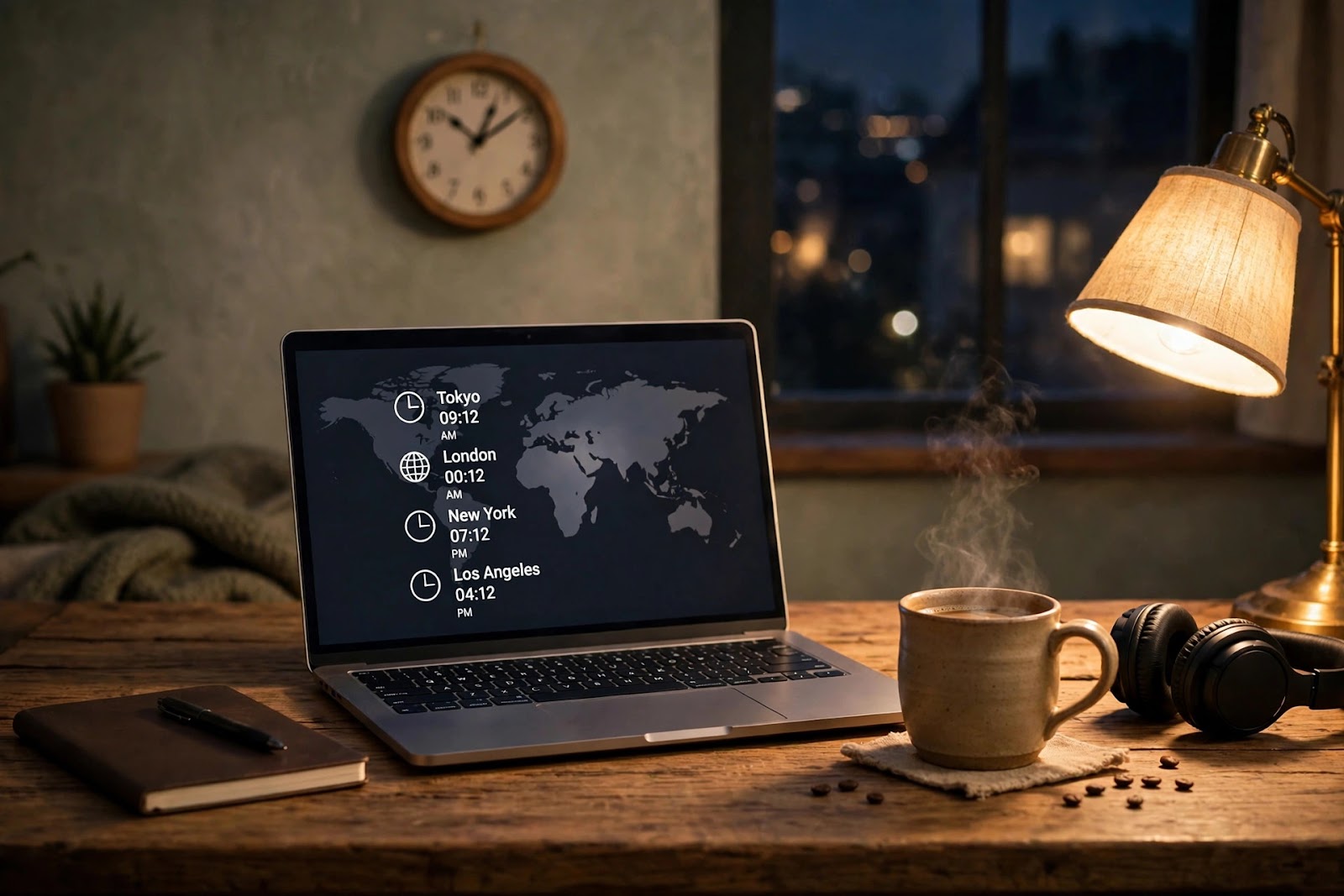
My working day is split into two windows now. The first runs from about 8 a.m. to 1 p.m., and the second from 4 p.m. to 8 p.m. The gap in the middle is mine. I eat properly, I walk, I do the boring admin I used to do at midnight. Clients in Australia and Asia get the morning window. Clients in the UK get the late morning and early afternoon. Clients in the US get the evening window.
I tell new clients this during the discovery call, before any money changes hands. Not as an apology, just as a fact: these are my working hours, this is when I am at my desk and at my best, and anything you send outside those hours I will pick up first thing in my next window. I say it plainly, in the same tone I would use to tell them my rate. Most clients nod and move on. The ones who push back at that point are telling me something useful about how the project will go.
What surprised me is how little this costs me. I assumed clients would see limited hours as limited service. The opposite happened. Because I answer inside my windows quickly and properly, clients feel looked after. A reply that arrives in four hours, complete and useful, beats a reply that arrives in four minutes at 1 a.m. and says "will check tomorrow" every single time.
Everything important goes in writing before the first call
Calls across time zones are expensive. Not in money, in coordination. Every call needs two people, two calendars, and two people awake at the same time. So I made a rule: nothing important lives only in a call. After every call, I send a short email the same day. What we agreed, what I am doing next, and when they will see it. Three or four lines, no more.
That email has saved me more times than I can count. A client once told me on a call that they wanted the homepage rewritten, and two weeks later they were sure they had asked for the whole website. My follow-up email said homepage, with the date on it. No argument, no bad feeling. We just looked at the email together and laughed about it.
I also write down every decision in a shared document the client can see. Deadlines, feedback, the current version of the file, all in one place. When a client wakes up on the other side of the world, they do not have to wait for me to wake up too. They open the document and they know exactly where things stand. That is what working across time zones actually means: the work keeps moving while one of you is asleep.
Async is my default, and calls are the exception
This was the hardest habit to build, because I like talking to people. But here is the honest maths: a client in Sydney and a client in New York are never awake at the same time as each other, and both of them are awake at different times from me. If every decision needs a call, the project moves at the speed of the slowest calendar. If decisions can happen in writing, the project moves while everyone sleeps.
So most of my updates are short recorded videos now. I open the work on my screen, I talk through it for three minutes, and I send the link. The client watches it over breakfast, leaves comments, and by the time I sit down again the feedback is waiting. No scheduling, no missed calls, no "sorry, can we move this to Thursday?" It took me a week to get comfortable recording myself, and it gave me back about five hours a week.
I still do live calls, of course. Kickoff calls, tricky feedback, the moments when a client is unhappy and needs to hear a human voice. Those are worth the calendar juggling. But a call to say "here is the draft, what do you think?" is a waste of two people's mornings. Send the draft. Let them think about it properly. You will get better feedback, and you will both keep your evenings.
The midnight-call request, and the sentence that handles it

It still happens. A new client will ask for a call at a time that is unreasonable for me, usually without realising it. They are not being rude. They looked at their own calendar, found a free slot, and sent the invite. The test is not whether they ask. The test is what I do next.
I used to write long, apologetic paragraphs explaining time zones, daylight saving, and my sleep schedule. Now I write one sentence: "That time is past midnight for me — would 7 p.m. my time work for you instead? That is 10 a.m. your time." Then I offer the converted time so they do not have to do the maths. Nine times out of ten, they reply within minutes: "Oh! Of course, sorry, that works great."
The tenth time, the client insists. The call really has to be at that hour, or the project really needs someone in their time zone. That is useful information too. I have turned down two projects for exactly this reason, and I do not regret either one. A project that starts by asking you to work at 2 a.m. does not get more reasonable later. It gets worse, because you have already shown them you will say yes.
The small systems that do the remembering for me
I do not trust my brain with time zones anymore. My calendar shows two time zones side by side, mine and my busiest client's, so I can see clashes before I agree to them. Every invite I send includes the time in the client's zone in the title, in plain words, so nobody has to convert anything. "Call — 7 p.m. PKT / 10 a.m. EST." It looks fussy. It has prevented exactly the kind of missed call that used to ruin my week.
I also keep a one-line note for each client: their city, the difference from my time, and whether their clocks change in March or November. The US and the UK change on different weekends, and Australia changes in the opposite direction entirely, because their summer is our winter. I got caught by that once, joined a call an hour late, and spent the whole meeting apologising instead of working. Never again.
One more small thing: I confirm the time the day before, in both zones, in the same message where I say what the call is about. "Tomorrow, 7 p.m. my time, 10 a.m. yours — we will go through the homepage draft." It takes twenty seconds. It kills the entire category of "wait, which time did we say?" messages that used to eat my mornings.
What I would tell myself back on that 2 a.m. call
If I could go back to that night, sitting at my desk in the dark with cold coffee, I would tell myself three things. First, the client did not need me at 2 a.m. They needed a clear answer, and an email would have given them one faster. Second, saying no to a time slot is not saying no to the client. It is saying yes to doing good work for them when I am actually awake. Third, the freelancers who last are not the ones who answer fastest at the worst hours. They are the ones who are still sharp, still reliable, and still enjoy the work five years in.
Working across time zones is one of the best parts of freelancing, honestly. I have had breakfast while a client in Sydney signed off for the day, and I have finished a project in my evening that a client in New York woke up to. There is something quietly wonderful about work that travels while you sleep. It only works, though, if you protect the hours when you are actually at your desk doing your best work.
So draw your overlap map, pick your windows, and write it all down. Tell your clients your hours before they have to guess them. And the next time a calendar invite lands at 2 a.m., do the maths once, smile, and send the one sentence that moves it to a time when you are both awake. Your future self, the one who slept properly and did good work the next day, will be grateful.


